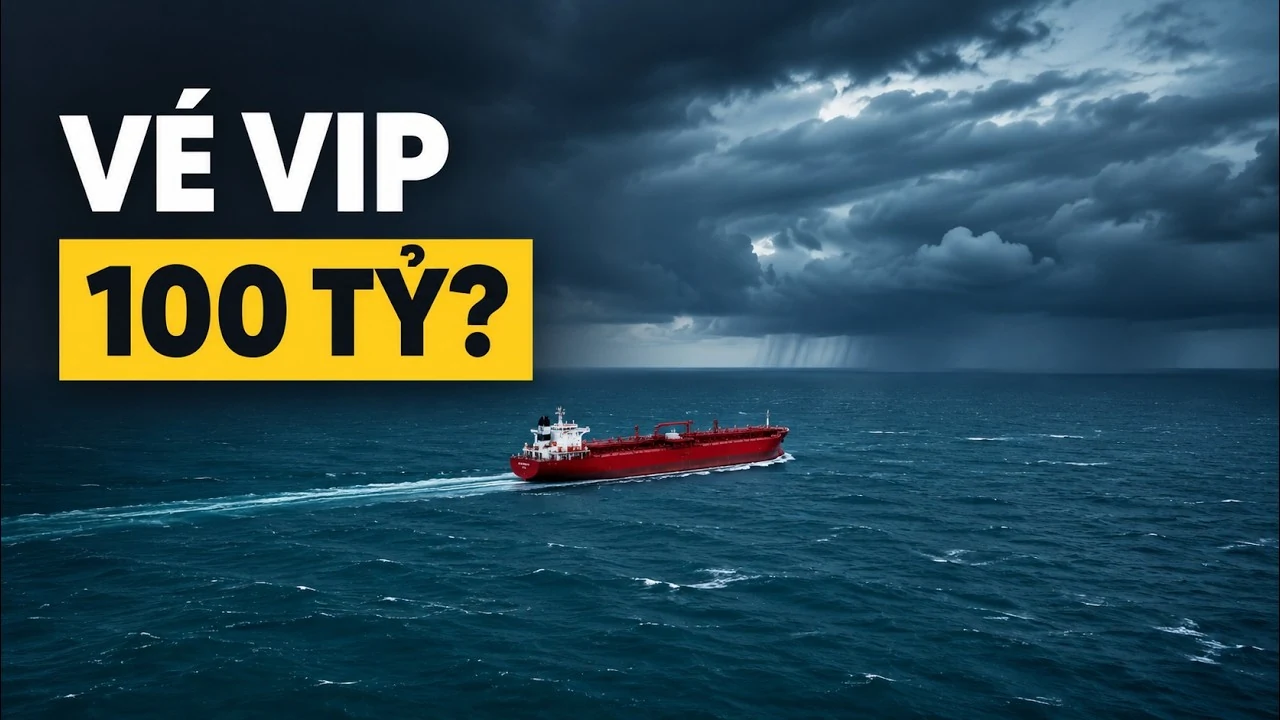
A VIP Pass Worth Nearly 100 Billion Dong
Suggested visuals A ship in the Caribbean, a line of waiting vessels, then a graphic showing the price of jumping the queue.
In November 2023, a Japanese liquefied gas carrier was sailing from the United States to Asia when it stopped in the Caribbean. Its engine hadn’t failed, and it hadn’t run out of fuel. It was following a ritual every ship in those waters had to observe: joining the queue. More than two hundred other ships were already ahead of it, waiting too.
They were all waiting to cross a single canal: the Panama Canal.
The owners couldn’t afford to wait much longer, so they did something unprecedented in the canal’s more than 100-year history. They paid nearly four million US dollars, almost 100 billion Vietnamese dong at the exchange rate then, just to go first.
Nearly 100 billion dong for one trip through an 80-kilometer canal. Doesn’t that sound insane? Where did that price come from? To make sense of it, we have to go back to where it all began: a narrow strip of land called Panama, between two continents, where two oceans lie close together but ships couldn’t cross.
From that strip of land we’ll go from eye-opening numbers to the people who work day and night to keep traffic flowing between the two oceans. Along the way we’ll answer three questions people keep asking. How long does a ship wait to enter the canal? How much does one transit cost? And how many hours does it take to cover those 80 kilometers?
Why the Canal Is a Shortcut
Suggested visuals Show a map of the two oceans. Draw two routes in different colors with the same start and end points.
On a map, Panama is a narrow strip of land linking North and South America, only a few dozen kilometers across at its narrowest. The two oceans come so close here that, standing on one side, you can almost picture the shore on the other.
Before the canal, a ship couldn’t simply cross whenever it needed to. A voyage from one coast of the Americas to the other had to go all the way down to the continent’s southern tip, round the wildest cape on the planet, and then head back north. The line grew longer on the map, and the ship’s fuel and time costs added up.
That’s why, when the canal opened in 1914, it felt like more than an engineering project. It was a geographical miracle that turned three weeks at sea into one leisurely day. That was on an ordinary day. What about the days that were anything but ordinary?
Transiting the Canal and Waiting at Sea
Suggested visuals Show two markers labeled “Transit” and “Waiting at sea.” Cut to the queue of ships and the lake’s falling water level.
According to the Panama Canal Authority, a ship takes an average of eight to ten hours from the moment it is allowed to enter to the moment it emerges at the other end. Eighty kilometers in eight to ten hours. It sounds like an easy day out, but that’s just the time inside the canal. The wait to get in can be dozens of times longer.
On a normal day, the Panama Canal handles about 36 to 38 ships. Then a historic drought hit in late 2023. That October was the driest month ever recorded in the canal’s watershed. Lake Gatún hit a record low, and the canal authority had to cut daily traffic from 38 ships to 22.
Imagine a highway suddenly losing half its lanes while the same amount of traffic keeps pouring in. In August 2023, more than 200 ships crowded the anchorages at both ends, and some had to wait more than 20 days. For large container ships, waits sometimes reached 16 or 17 days, longer than it took them to cross the Pacific.
A lot of you who saw our previous video asked a great question. The canal sits between two oceans. With all that seawater, how can it run short of water? Why not run the locks with seawater? Why use fresh water and make ships wait so long? Of course the engineers already know these questions. But aren’t you curious why they’ve decided against it?
Fresh Water and Lake Gatún
Suggested visuals Show a cross-section of the lake and locks. Animate the water rising and falling in stages, then cut to the household water supply.
The answer lies in Lake Gatún, the heart of the canal. Gatún is a vast artificial lake created more than a century ago by damming the Chagres River. Its surface stands roughly 26 meters above sea level. Its fresh water is what allows those enormous ships to cross the Panama Canal.
Water flows by gravity from the lake into the locks. When the water in a chamber rises or falls, the ship moves with it, making its way up and down between the two oceans. That remarkable system comes at a high price. On average, each transit through the original locks uses nearly 200 million liters of fresh water.
Operating measures can save some of it, but water released into the sea doesn’t flow back into the lake on its own. More than 30 ships can go through the canal in a day, and the water that keeps it running depends on rainfall across the watershed and the rivers that feed the lake.
When it rains less, the lake drops. If a drought drags on, the canal has to limit traffic to save water. And there’s an even bigger concern. Ships are only one of the things Lake Gatún serves.
Together with Lake Alhajuela, it forms part of the system that supplies water for everyday use to more than half of Panama’s population. So why not use seawater in the locks? Bringing saltwater into the system could increase the risk of salinizing Lake Gatún, threatening the quality of water millions of people depend on. Saltwater has already entered the lake through lock operations, and engineers have had to keep looking for ways to control it.
That’s the Panama Canal’s paradox. Every ship that passes through helps keep world trade moving, and every ship also uses some of the fresh water that people in Panama need to live. When severe droughts hit, the country faces a difficult question. How do you keep a vital global shipping route open and still protect enough water for your people?
The Cost of Waiting and the Slot Auction
Suggested visuals Show ships at anchor, the route around South America, then an auction card. Put US$3,975,000 on screen as the figure is spoken.
Waiting at sea is different from waiting on land. Each day a ship sits at anchor, its owner still pays crew wages, charter costs, and insurance. Some owners couldn’t afford the wait and bypassed the canal, sending their ships around the southern tip of South America through the Strait of Magellan. The Pyxis Pioneer did just that, adding nearly a month to its voyage.
Some owners stayed and paid to go first. The Panama Canal has an unusual system: it auctions transit slots. Each day, in addition to the slots that have already been booked, the authority reserves some for the highest bidders. In October 2023 alone, it held 140 auctions, three of which went for more than a million dollars.
Then on November 8, according to auction records obtained by Bloomberg, an all-time record was set. Japan’s Eneos paid $3,975,000 at auction just to secure a November 15 transit for its ship, the Sunny Bright.
That $3,975,000 was the auction price alone. Once the standard toll was added, the bill for one transit came close to four million dollars. Øystein Kalleklev, CEO of the shipping company Flex LNG, told Bloomberg that at that price many ships had been priced out.
Standard Canal Tolls
Suggested visuals Introduce the three vessel types in order. Show the ordinary toll separately from the auction price.
If the auction alone cost nearly four million dollars, you might be wondering what the standard transit toll is. According to the ACP’s published rates, it depends on the kind of vessel going through.
For a small boat under 20 meters, the toll is $1,935. For a somewhat larger yacht, around $5,500. For a giant container ship, the toll starts at $300,000, before charges for each container on board. For the very largest ships, the bill for a single transit can exceed a million dollars.
Those figures tell a story. This canal is a shortcut and a machine for printing money. But where does the money go?
How Panama Benefits
Suggested visuals Put ship transits, revenue, and profit in three separate boxes. Use an arrow to show how money flows into the treasury.
Fiscal year 2024 was an unusual one for the Panama Canal. Drought forced the canal to restrict traffic. Transits fell by more than 20 percent to 11,240. Yet revenue reached what was then a record, nearly five billion dollars. According to the ACP’s audited annual report, profit was about $3.44 billion, more than seven percent higher than the year before.
Panama’s constitution requires the canal’s surplus to go to the treasury after operating, investment, maintenance, expansion, and reserve needs have been met. So every passing ship pays for a shorter voyage and contributes to the public funds Panama uses to meet the country’s needs.
The ACP estimates that the canal’s direct, indirect, and wider effects amounted to about 6.3 percent of GDP in 2025, and that it directly employed more than 9,000 people. Yet few accounts mention the thousands of people who do jobs you might never imagine to keep the canal running smoothly every day. Let’s start with the pilots.
The People Who Guide Ships Through the Locks
Suggested visuals Show a pilot boarding, the clearance between the ship and the wall, the electric locomotives, and crews handling lines.
Under the ACP’s navigation rules, vessels entering the canal must take on a Panamanian pilot, and the captain must hand over full control. Think about that. A captain takes a ship halfway around the world, gets to the canal entrance, and hands the helm to a stranger.
These pilots have all captained large ships and must train for three years in the canal before taking the helm. Why so much care? Under the ACP’s technical standards, the original locks are just 33.5 meters wide, while the widest ships allowed through measure 32.3 meters across. Each side of the ship has less than 60 centimeters of clearance from the concrete wall. Sixty centimeters for a ship almost 300 meters long and weighing tens of thousands of tons, floating in moving water.
Electric locomotives called mules run on rails along both sides of the locks to keep ships from hitting the walls. A large ship needs as many as six of these iron mules. Two at the bow, two amidships, and two at the stern hold it straight with steel cables, as if it were on rails itself. Even a small bump against a lock wall could cost millions of dollars and block the entire canal.
For small pleasure boats, it’s a more down-to-earth story. To transit the canal, their owners must hire four professional line handlers and take a canal adviser on board. The rules also require them to provide food and drink for these workers throughout the trip.
The line handlers stand on the high lock walls, toss coils of rope down, and walk along the edge to guide the boats through each change in water level. Their work starts before sunrise and can last well into the night, because the canal runs 24 hours a day without a break.
The Value of Time and the Closing Sequence
Suggested visuals Return to the two routes from New York to San Francisco. End with a ship leaving the locks and a wide shot of the canal.
You might still be wondering why ships don’t simply skip the canal and take the long way around. The answer is in a figure from the ACP itself. Taking the Panama Canal cuts about 8,000 nautical miles off the trip from New York to San Francisco, compared with sailing around the southern tip of South America.
Eight thousand nautical miles means about three weeks at sea, crossing waters known as the roughest on the planet, compared with one easy day in the canal. In shipping, time is money, and those three weeks are worth far more than the transit bill.
More than a hundred years ago, people dug this canal to shorten the distance between two oceans. That is still what it does today. The difference is that the price of that shorter journey is being calculated ever more precisely, down to the dollar.
Around 13,000 to 14,000 vessels cross the canal each year, carrying roughly five percent of the world’s seaborne trade. Each transit brings in hundreds of thousands of dollars in fees. Every dollar goes into the budget of a small Central American country.
Perhaps the Panama Canal’s greatest legacy lies beyond the numbers on the bill. A narrow strip of land dared to bring two oceans together. From that day, the map of world trade changed forever. Goods reached consumers at lower prices, and voyages around the world’s most dangerous cape slowly fell away. Distances between continents were measured in days instead of weeks.
More than a century later, every ship through the canal still reminds the world that the greatest changes sometimes begin with a small country willing to think big and keep two oceans meeting, day after day.
Two Lines to Listen to Again Before Quoting Verbatim
06:09–06:20. The captions give “nearly four million dollars” as the total bill, while the draft says “nearly four and a half million dollars.” The narration above follows the captions here.
06:31–06:38. The autogenerated captions say “500 dollars” for a yacht. The narration above uses “5,500 dollars” from the PANAMA.txt draft. The rates are retained as part of the video as originally produced.