Opening and the Origin of the Name
Have you ever heard of the Silk Road and wondered where it really was, where it began, how far it stretched, and why people in the past created such a dangerous journey?
If you really want to find the answers, stay with us until the end of the video. We’ve carefully gathered some fascinating things you may never have heard before.
The first surprise is that the Silk Road wasn’t a single road. It had no starting line, no milestones, and no straight route connecting China to Europe. It was an entire network of land and sea routes that branched and rejoined, flowing across much of Eurasia.
Even the people who traveled those routes never called them the Silk Road. The name appeared only in the nineteenth century, when the German geographer Ferdinand von Richthofen used the term Seidenstraße to describe the ancient trade network between East and West.
In other words, the route had existed for more than 2,000 years before it got the name we know today.
Zhang Qian’s Mission
Trade across Central Asia began very early. Yet the turning point that set this network on a path to rapid growth began with a mission that had nothing to do with trade.
Around 139 BCE, Emperor Wu of Han faced a threat from the Xiongnu to the north. He sent his envoy Zhang Qian west to find the Yuezhi, hoping to form a military alliance against their common enemy.
But Zhang Qian was captured by the Xiongnu before he could complete his mission. Held for years, he eventually escaped and continued through lands almost entirely unknown to the Han court.
After thirteen years, Zhang Qian returned to Chang’an. He hadn’t secured the alliance the emperor wanted, but he brought back something of greater lasting value: information.
His report described wealthy Central Asian city-states, markets full of unfamiliar goods, and roads leading farther toward Persia, India, and the Western world. He spoke in particular of the strong horses of the Fergana Valley, which the Han desperately needed to strengthen their cavalry.
A failed diplomatic mission opened an entirely new opportunity. The Han court began sending more delegations, carrying gold and silk to establish relations with lands to the west.
A transcontinental trade network gradually took shape from paths that local merchants already used.
The Routes and the Value of Silk
On a modern map, a typical land route would begin in Chang’an in China, skirt the Taklamakan Desert, then cross Central Asia, Persia, and Anatolia to reach the Mediterranean and Europe. Other branches ran south from the main route toward Afghanistan, India, and southern seaports.
Yet hardly any merchant traveled all the way from China to Rome. Goods passed from one group of traders to the next, changing hands at each stage. The farther they went, the higher the costs and risks, until something ordinary at the point of departure could become a treasure at the other end.
Let’s stop and think for a moment. What could be valuable enough for people to brave deserts, snowy mountains, bandits, and thousands of kilometers of uncertainty?
The answer begins with silk. Silk drew the West toward China, while warhorses, treasure, and knowledge from the West kept China looking beyond its borders. That pull in both directions turned scattered trails into a network that changed Eurasian history.
Silk had an almost perfect advantage in long-distance trade. It was light, easy to carry, and extremely valuable. A camel could carry silk worth far more than a load of grain, timber, or other heavy goods.
For centuries, China guarded the techniques of raising silkworms and reeling silk as a state secret. This gave it a near monopoly on the fine, light, shimmering fabric that Western aristocrats couldn’t yet produce themselves.
As silk reached Central Asia, Persia, and the Mediterranean, its value rose each time it changed hands. The final buyer paid for the cloth itself, thousands of kilometers of transport, taxes along the way, food for the caravan, and the risk of losing everything in the desert.
A roll of silk left China as merchandise and arrived in Rome as a symbol of power and status. Demand among wealthy Western buyers was so great that Chinese silk continued to cross empire after empire, even though most buyers and sellers at opposite ends had never met.
Chinese merchants rarely made it to Rome themselves, and Roman merchants seldom appeared in Chang’an. A succession of intermediary communities kept the trade moving. Sogdians in Central Asia, Persian merchants, Parthians, Indian trading caravans, and others took goods for one leg of the journey and sold them on to the next group.
The Silk Road worked less like a train running from its first station to its last and more like a vast relay race. Goods kept changing carriers, yet always moved forward.
Goods, Knowledge, and Religion
Silk was the most famous thing to travel west from China, but it was never the only one. Over the centuries, traders also carried lacquerware, ceramics, paper, metals, medicinal materials, and other crafts. Techniques such as papermaking, printing, compass-making, and the production of gunpowder eventually spread to other regions through these networks of exchange.
In the other direction, what the Han initially wanted most was neither gold nor silver, but strong, hardy warhorses from the Fergana Valley. Zhang Qian’s report made Emperor Wu realize how much they could help his cavalry fight the Xiongnu.
Silk therefore went west for profit and in exchange for military strength and a better chance of defending the frontier.
Along with horses, goods from Central Asia, South Asia, and the Mediterranean flowed into China: glass, precious metals, gemstones, carpets, wool, cotton, aromatics, and wine. Glass vessels from the Roman world made a strong impression in the East because their craftsmanship differed so much from familiar Chinese pottery and lacquerware.
Trade made its way straight to the dinner table, too. Grapes, alfalfa, and other crops from the West reached China, while rice, pears, and other Eastern produce spread to new regions. The Silk Road changed what filled palace treasuries as well as what grew in fields, what went into kitchens, and how people ate.
Goods weren’t even the most influential things on the move. Monks, scholars, envoys, artisans, and pilgrims traveled alongside merchants. Buddhism moved from India through Central Asia into China. Eastern Christianity, Zoroastrianism, Manichaeism, and Islam later spread along different branches. Trading cities began to take on places of worship, languages, and customs from many lands.
People traded products, watched how they were made, learned the techniques, and carried them elsewhere. Papermaking spread westward, and knowledge of glassmaking and metalworking traveled east. Persian patterns appeared on Chinese objects, while Eastern silk was reworked to suit Central Asian tastes.
By then, the Silk Road had grown beyond trade. It had become the ancient world’s largest network for spreading knowledge, where an idea could reach just as far as a camel caravan.
The road, however, couldn’t choose what crossed it. Alongside silk, knowledge, and religion, it carried bands of robbers, armies, and pathogens across borders that had once held them back.
Risks and How Merchants Protected Themselves
The Silk Road’s greatest strength, its ability to connect a whole continent, gradually became its most dangerous weakness. Calamity could travel just as far as prosperity.
The more valuable the cargo, the greater the danger that came with it. A caravan could lose everything to a sandstorm, snowy mountains, a shortage of water, or an attack in a place where nobody could come to its rescue.
Robbery was only one danger. When war broke out or an empire weakened, rival powers could carve up the routes. Each could put up another checkpoint, levy another tax, or simply make the land ahead impassable.
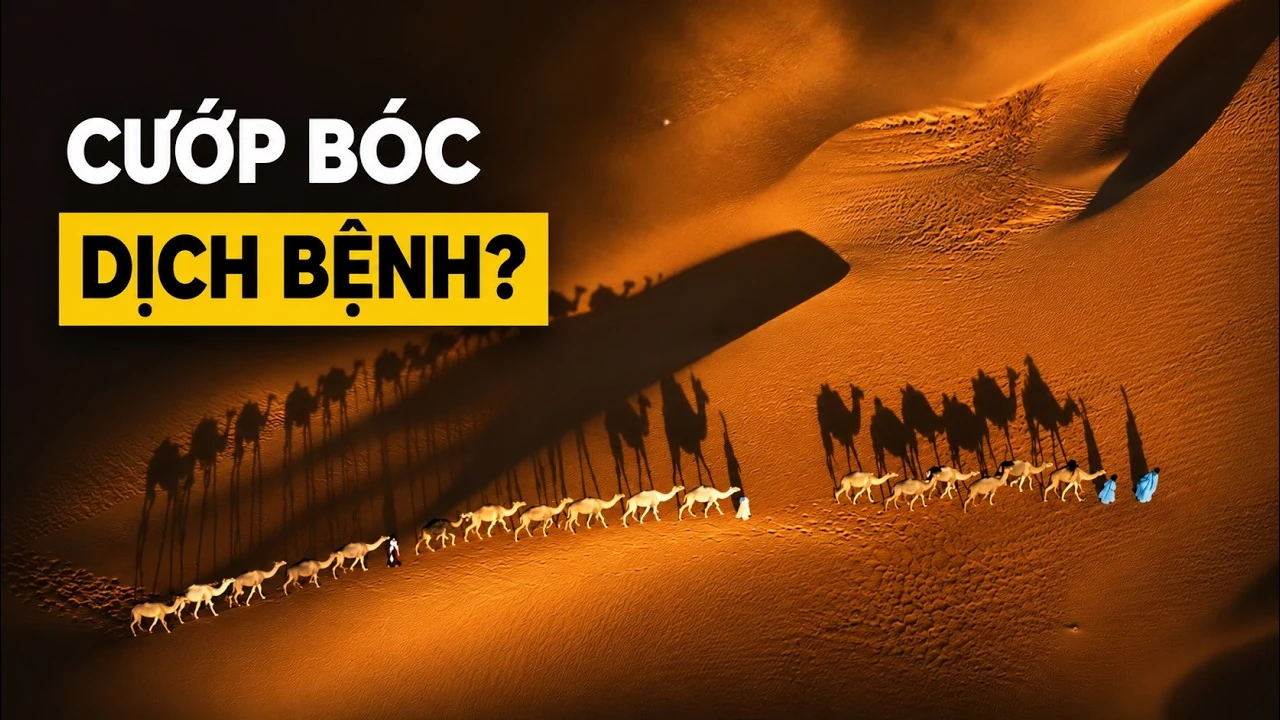
To survive, merchants could no longer travel alone as they once had. They gathered in large caravans and hired guides, interpreters, and guards. Two-humped camels were widely used because they could carry heavy loads, withstand the cold, and cope better with Central Asia’s dry terrain.
Even a large caravan couldn’t keep going without stopping. Caravanserais began to appear along the trade routes, large roadside inns with walls and protected gates.
Inside were drinking water, food, rooms, storage, and facilities for tending animals. Merchants could stay overnight, repair equipment, exchange currencies, find interpreters, and hear news of the road ahead. Some stops grew into markets, then towns, and eventually thriving cities.
The Silk Road therefore carried goods and built a system of services of its own, much like modern life: wells, forts, inns, markets, and towns that sprang up in places where scarcely anyone had lived before.
The network’s safety, however, always depended on political power. When an empire was strong enough to control a vast territory, merchants traveled more easily and trade thrived. When that empire broke apart, new upheavals followed and the road quickly grew dangerous again.
The Mongol Empire and Disease
The thirteenth century saw an unusual period. The Mongol Empire controlled much of Eurasia, bringing many lands under one vast system of power. Envoys, merchants, and missionaries found it easier to travel, and exchange between East and West entered a lively new period.
The more freely traffic moved through the network, the farther an unseen danger could travel. Beyond the upheaval, the Silk Road had another, more troubling problem.
The Silk Road didn’t create disease, yet it helped diseases cross distances that had once protected people. The Plague of Justinian, and especially the fourteenth-century Black Death, spread along trade networks, shrinking populations, bringing production to a standstill, and breaking many trade routes.
At the same time, the Mongol Empire broke into rival centers of power. Routes that had once been protected grew less stable, more expensive, and more dangerous.
Maritime Trade and Legacy
So why did the Silk Road disappear? A war, a pandemic, or the rise of a new empire could explain only part of it.
What truly displaced it was a rival that could carry more goods at a lower cost: shipping by sea.
From the late fifteenth century, shipbuilding and navigation advanced rapidly. European sailors found a way around Africa into the Indian Ocean, giving them direct access to Asian markets. A ship could carry far more than a camel caravan while avoiding numerous tax posts and changes of ownership on land.
This was when people began to recognize that trade was changing course. Overland branches still served regional trade for centuries, but they no longer dominated trade between East and West. Cities deep in the interior gradually lost their advantage as seaports grew richer and more powerful.
The Silk Road weakened over time as the flow of goods slowly left the desert and moved to the ocean.
Its legacy, though, never went away. Chinese silk, Roman glass, Fergana warhorses, crops from distant lands, papermaking, and major religions all left traces in the places they passed through.
Taken together, the story follows a clear arc. The Silk Road began with a failed mission to find an ally, grew as civilizations sought new things, and gradually lost its standing when the ocean offered a faster, cheaper route than the desert.
Yet the road never truly disappeared. Caravans might stop and markets might fall silent, but crops, techniques, religions, and ideas could never be called back once they had crossed a border.
From the moment East and West found each other along those routes, the world entered a more connected, culturally diverse, and developed age.